
Introduction
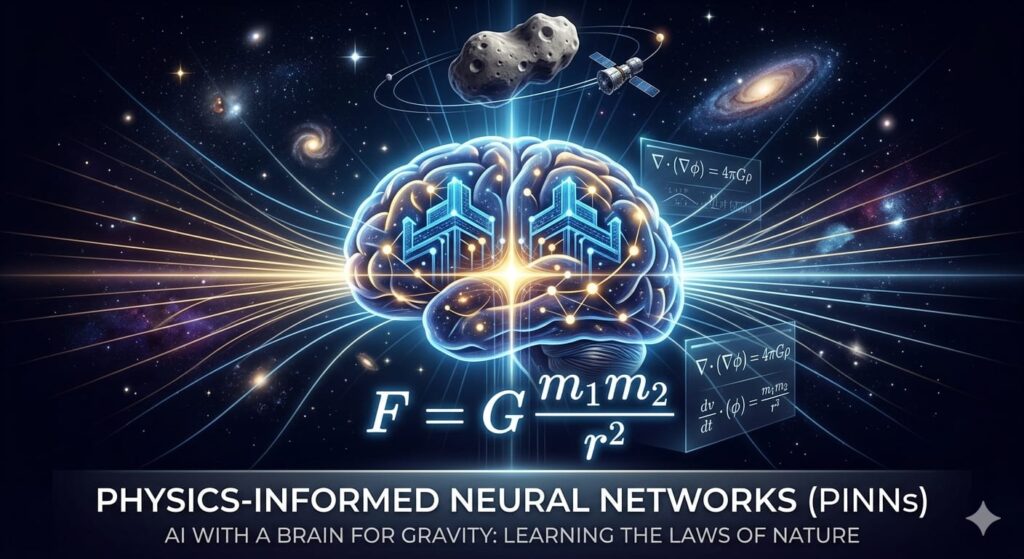
In the early days of AI, if you wanted a neural network to predict how an apple falls from a tree, you had to show it ten thousand videos of falling apples. Even then, if you showed it a grape, it might get confused. Traditional AI is data-hungry and physics-blind—it looks for patterns in pixels but has no idea that F = ma. But a new breed of AI is changing the game. Physics-Informed Neural Networks (PINNs) are essentially neural networks that have been “forced” to read a physics textbook before they start learning from data. They don’t just learn from what they see; they learn from what the universe says is possible.
The “Black Box” Problem
Standard AI is often called a “black box.” It’s brilliant at finding correlations, but it doesn’t understand causality or the laws of nature. If you train an AI on satellite trajectories and it sees a gap in the data, it might suggest a path that violates the laws of thermodynamics or sends the satellite teleporting through a moon.
• Zero Context: It only knows the numbers you give it, not the “why” behind them.
• Data Dependence: It needs massive datasets to “guess” the underlying rules of motion.
• Brittleness: If the scenario changes slightly (different gravity, new altitude), the model often fails.
How PINNs Work: AI with a “Conscience”
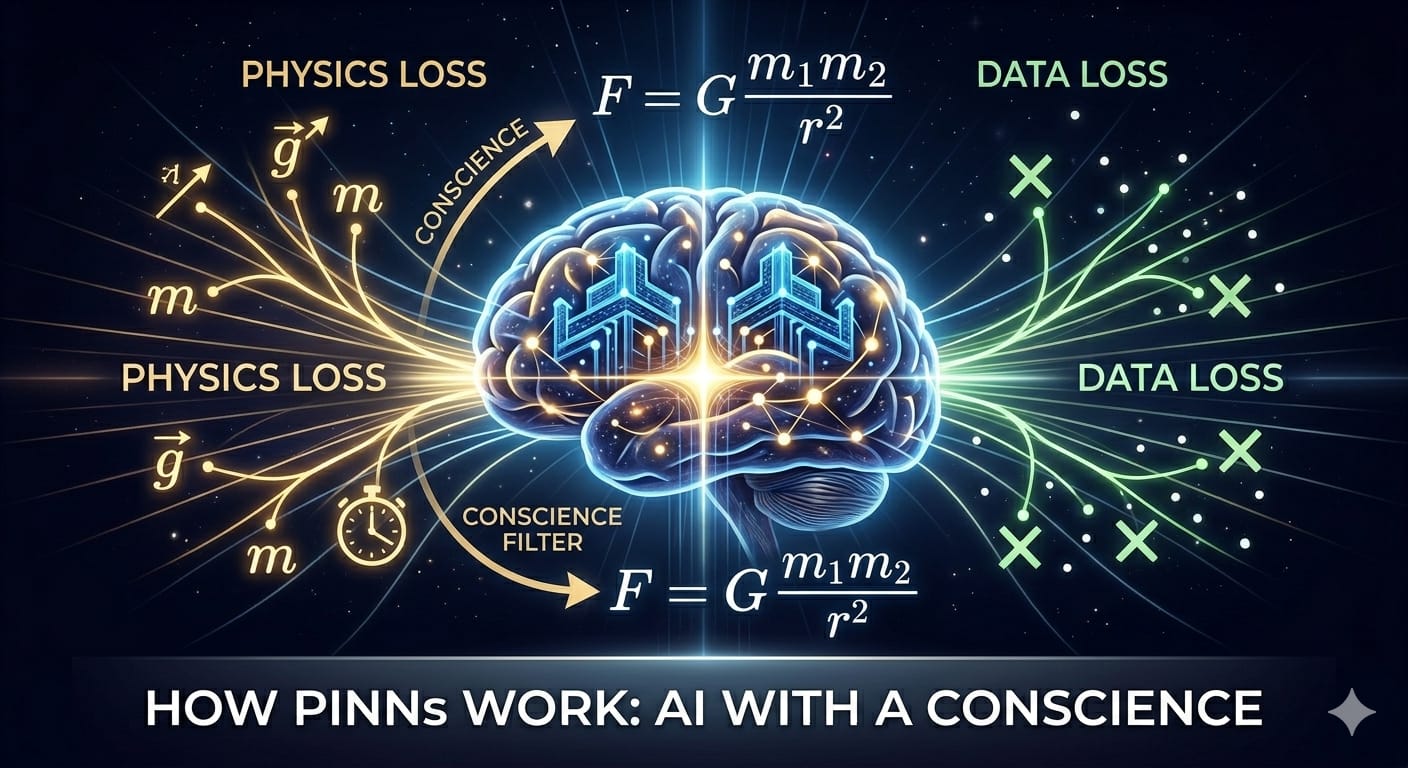
PINNs solve this by baking physical laws directly into the AI’s “brain” via the loss function. When we train a PINN for gravity, we don’t just ask, “Is this where the planet is?” We also ask, “Does this trajectory satisfy the fundamental equations of physics?”
Loss = Loss(data) + Loss(physics)
- Input: Coordinates in space and time (x, y, z, t).
- The Neural Network: Predicts a value, like gravitational potential or velocity.
- The Physics Filter: Using Automatic Differentiation, the AI calculates its own derivatives.
- It checks: Is my predicted acceleration consistent with the mass nearby?
- The Penalty: If the AI’s prediction breaks a law (e.g., ∇²Φ = 4πGρ), the “Physics Loss” spikes, and the AI is forced to correct its course.
Gravity 2.0: Mapping the Invisible
Gravity is notoriously hard to map precisely. Earth isn’t a perfect sphere; it’s a lumpy “geoid” with different densities. For irregularly shaped objects like the asteroid Eros, gravity is a chaotic mess that traditional formulas struggle to describe efficiently.
PINNs are now being used to:
Model Asteroid Gravity: Learning the gravitational field of jagged asteroids to help spacecraft land safely.
Clean Up “Noisy” Data: Satellite measurements are often imperfect. PINNs act as a filter that knows what real gravity should look like.
Predict Orbital Mechanics: Calculating complex “three-body” trajectories where Earth and Moon gravity fight for control. 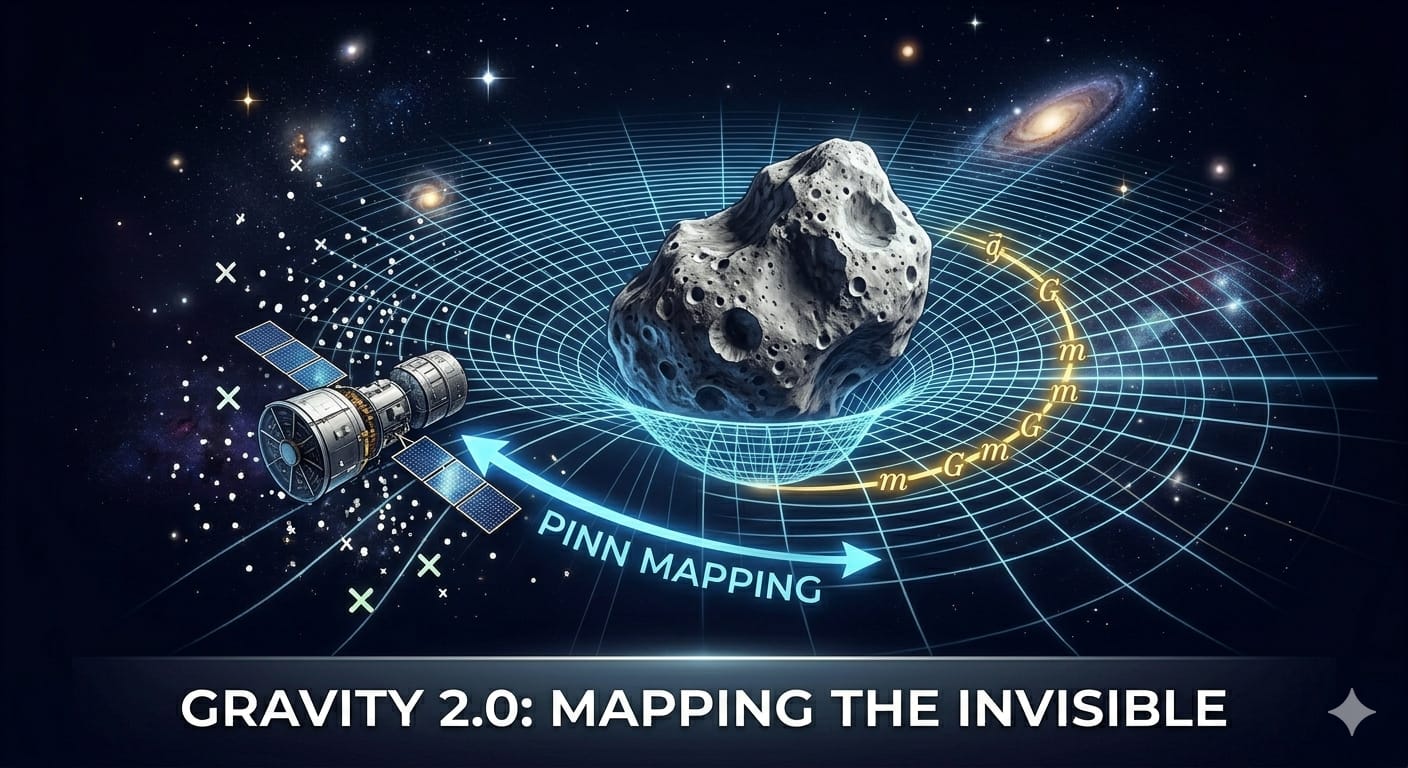
The Future: Toward “Scientific AI”
We are moving away from AI that just recognizes patterns and toward AI that understands the universe. Whether it’s predicting climate change, designing fusion reactors, or navigating the gravity wells of distant moons, PINNs are ensuring that AI isn’t just smart—it’s scientifically literate.