
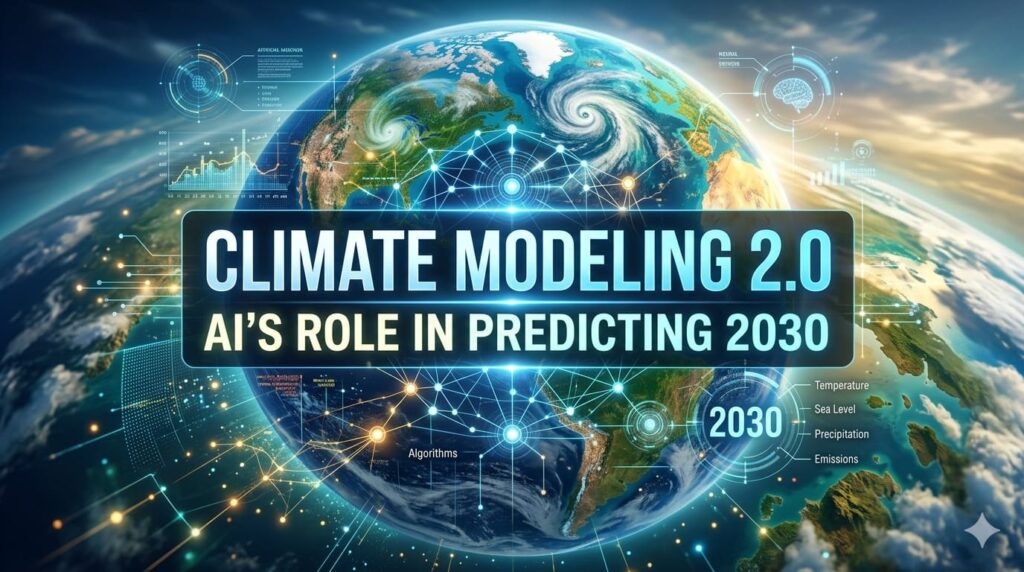

The race against climate change has always been a battle of data. For years, scientists relied on physics-based models that, while brilliant, were computationally heavy and sluggish. They were like trying to map the world using a hand-drawn compass—accurate in principle, but slow to adapt.
Climate Modeling 2.0.
By 2026, we’ve entered a new era where Artificial Intelligence isn’t just an assistant; it’s the engine driving our understanding of the planet’s future. As we look toward 2030, AI is transforming climate science from a slow, retrospective analysis into a lightning-fast, predictive powerhouse.
Why the Shift Matters
Traditional models often took weeks to simulate a few decades of atmospheric change on massive supercomputers. Today, AI emulators are compressing those same calculations into mere hours, or sometimes minutes.
This speed isn’t just about efficiency; it’s about granularity.
Hyper-Local Forecasting: Instead of broad regional guesses, AI can now zoom in on microclimates. Whether it’s predicting the path of a hurricane in seconds or analyzing how a specific neighborhood might handle a heatwave, the precision is unprecedented.
Decoding Complex Systems: Our climate is a web of oceans, forests, ice, and atmosphere. AI, specifically through Graph Neural Networks (GNNs) and physics-informed models, is finally mapping these non-linear relationships, helping us see “tipping points” before they become catastrophes.
Empowering Policy: With AI-driven scenario planning, policymakers don’t have to guess the outcome of a new carbon tax or a switch to renewable energy. They can simulate thousands of “what-if” scenarios instantly, making data-backed decisions the new standard.
The 2030 Outlook
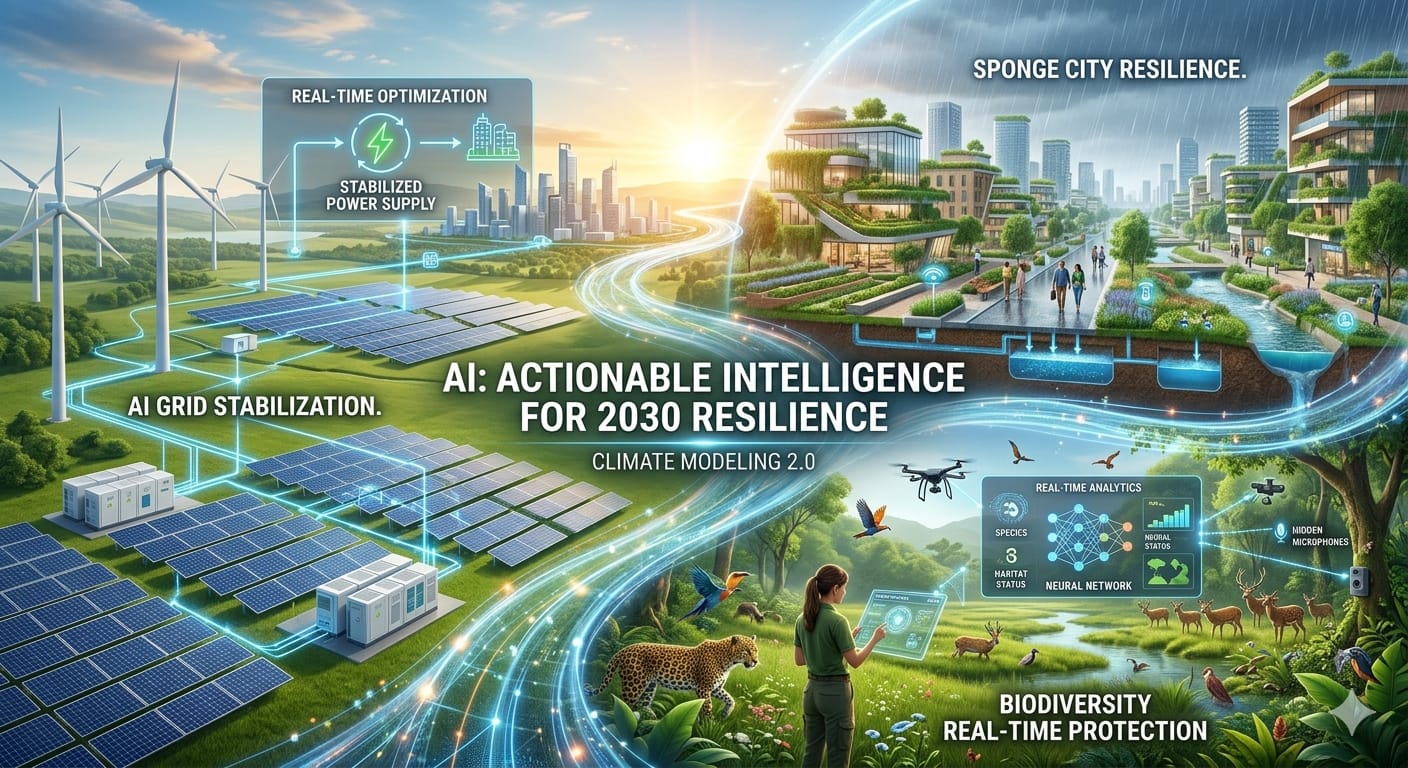
As we march toward 2030, the goal is simple: Actionable Intelligence. We are moving past the phase of just observing the warming to actively modeling our resilience. AI is helping grid operators stabilize energy supplies, guiding urban planners to build “sponge cities,” and helping conservationists protect biodiversity in real-time.
The AI revolution in climate science isn’t promising a crystal ball—but it is giving us the next best thing: a high-definition, real-time map of the road ahead. And for the first time, we have the tools to navigate it.