
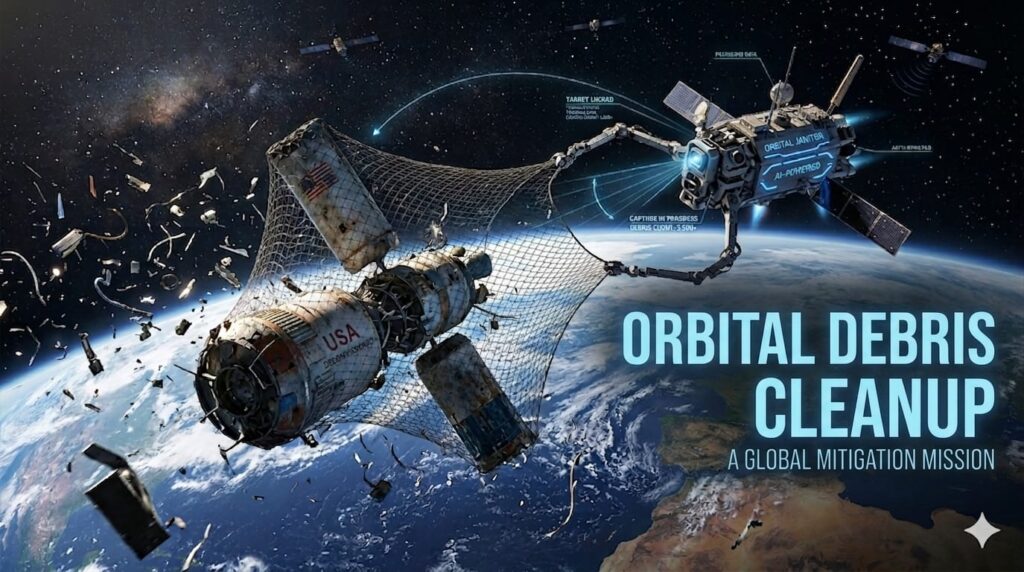

For decades, humanity has looked at the stars with a sense of wonder. We have launched thousands of satellites, built an international laboratory in the sky, and paved the way for global internet networks. But our rapid expansion into the cosmos has left behind a dark, chaotic footprint: space junk. Right now, Earth’s orbit is looking less like a pristine frontier and more like a cosmic junkyard. Spent rocket stages, dead satellites, and even frozen flecks of paint are whizzing around our planet at mind-boggling speeds. Fortunately, a new generation of cosmic janitors is stepping up. By combining advanced aerospace engineering with Artificial Intelligence (AI), autonomous satellites are preparing to clean up our orbit before it’s too late.
The Invisible Threat Over Our Heads
To understand why we need AI in space, we first have to understand the scale and speed of the problem. According to tracking networks, there are over 35,000 objects larger than 10 centimeters currently tracked in orbit, and hundreds of millions of smaller fragments. Because things in Low Earth Orbit (LEO) travel at speeds around 17,500 mph (28,000 km/h), even a tiny piece of debris carries the kinetic energy of a highway car crash.
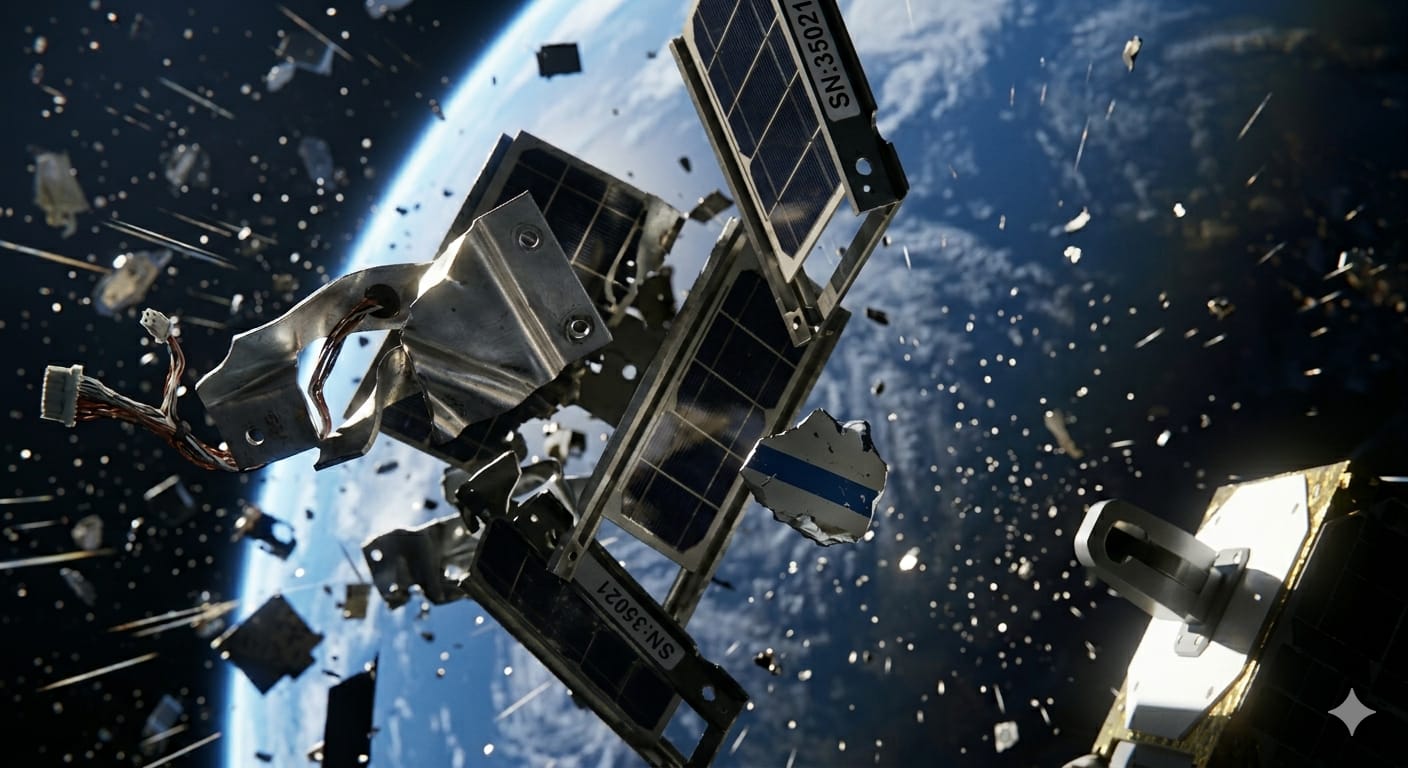
space debris
The Ultimate Risk: Kessler Syndrome
Proposed by NASA scientist Donald Kessler in 1978, this is a nightmare scenario . This could create an impenetrable blanket of debris, rendering space travel and satellite technology impossible for generations.
Enter Space Junk AI: The Autonomous Janitors
Here is how AI is transforming the cleanup process from a distant dream into an active reality:
1. Computer Vision and Target Identification – Space junk doesn’t sit still; it tumbles, spins, and reflects sunlight unpredictably. Cleanup satellites use AI driven computer vision—powered by LiDAR and optical cameras—to analyze a piece of debris in real-time. The AI maps the object’s shape, estimates its center of mass, and calculates its exact rotational spin.’
2. Autonomous Navigation and Proximity Operations – Approaching an uncooperative, tumbling piece of metal in zero gravity is incredibly dangerous. If the cleanup satellite miscalculates, it could strike the debris and create thousands of more fragments. Onboard AI algorithms run continuous physics simulations, making microscopic, real-time adjustments to the satellite’s thrusters to safely match the debris’ speed and trajectory.
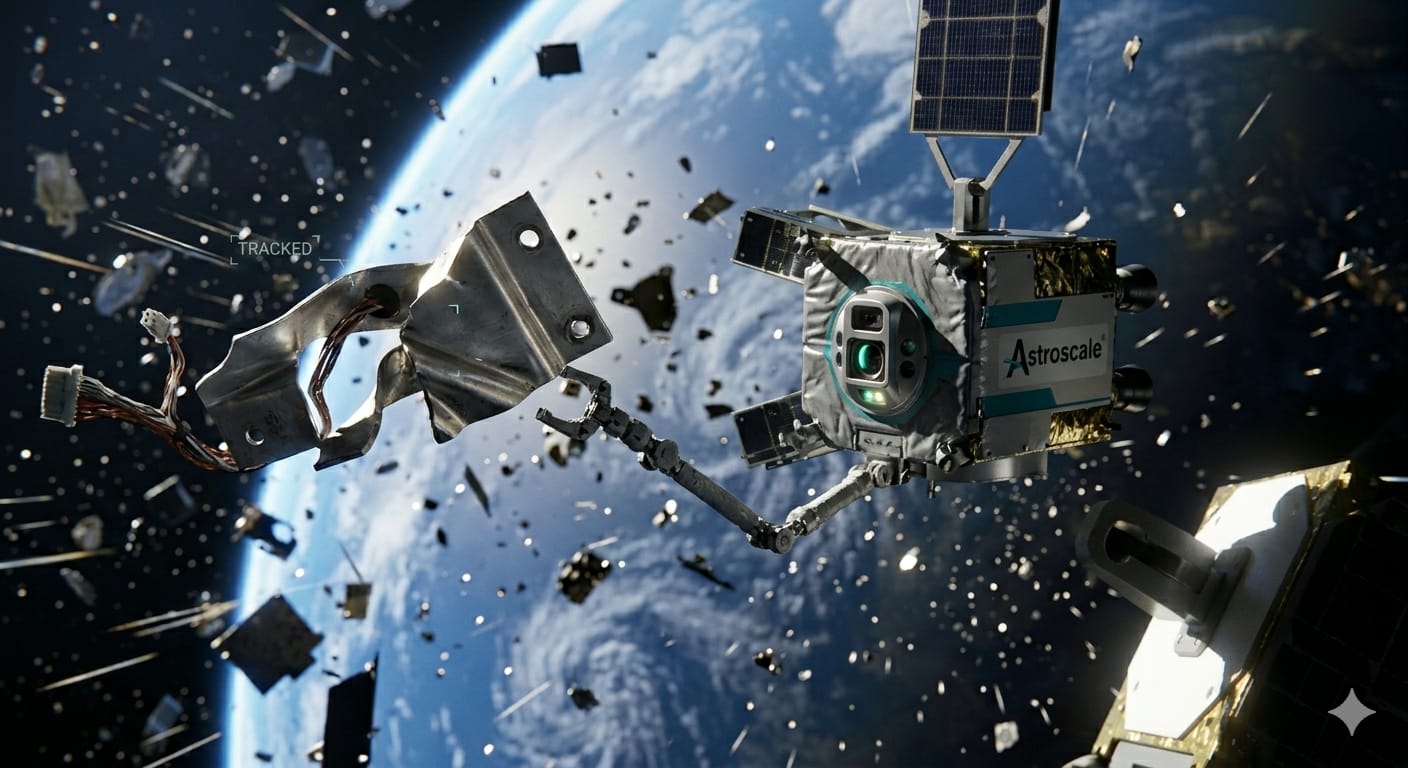
space cleaning
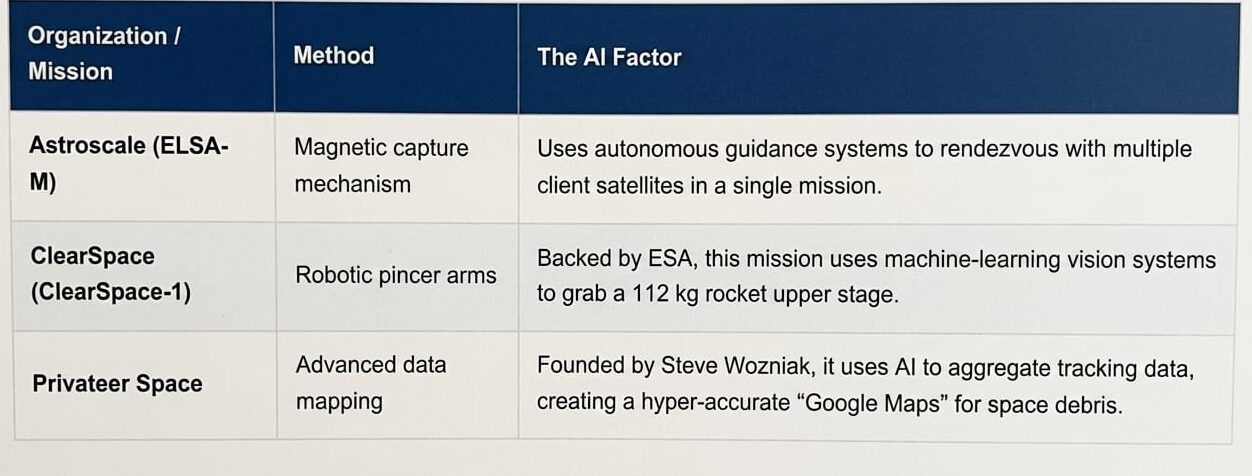
3. Smart Capture Mechanisms – Once close enough, the autonomous satellite must capture the junk. Companies are developing a variety of AI-guided methods:
Robotic Arms: AI calculates the perfect moment to grab a stable edge of a tumbling satellite.
Magnetic Harpoons & Nets: Algorithms predict the optimal firing window to deploy nets or magnetic tethers around oddly shaped debris.
Ion Beam Shepherding: Instead of touching the debris, the satellite uses an AI-directed plasma beam to gently nudge the object into a lower orbit.
4. Controlled De-orbiting – Once the target is secure, the autonomous janitor drags the piece of junk downward into Earth’s upper atmosphere, where intense friction safely burns both objects up.
The Bottom Line: Protecting Our Digital Future
By taking the human operator out of the loop and allowing satellites to think, see, and act on their own, Space Junk AI is stepping up to ensure that our cosmic highway remains safe, sustainable, and open for generations to come.