
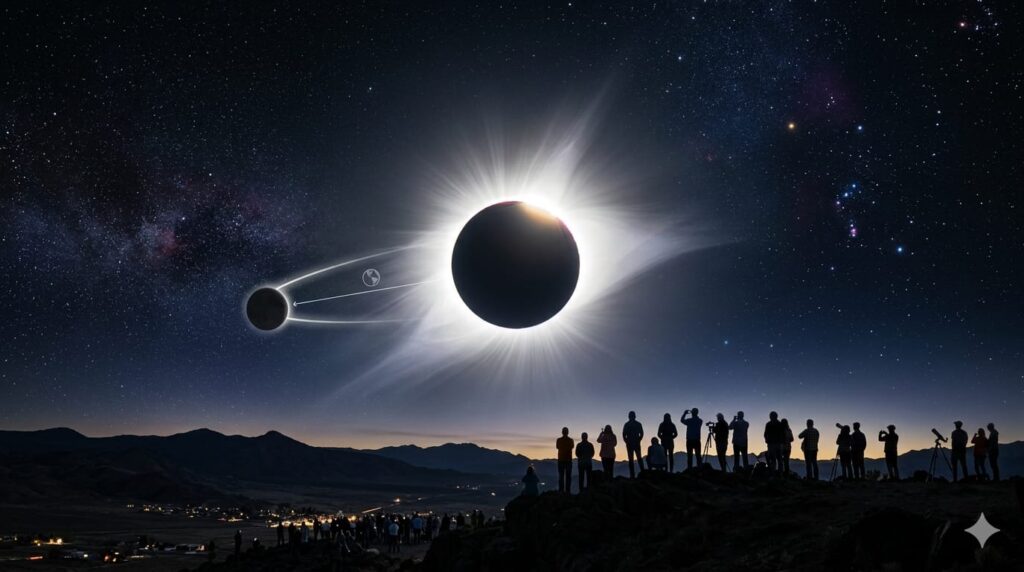

There is a profound, cosmic coincidence happening right above our heads, and almost everyone takes it for granted.
Right now, the Moon is about 400 times smaller than the Sun, but it also happens to be roughly 400 times closer to Earth. This perfect cosmic math allows the Moon to perfectly blot out the Sun’s fiery disc during a total solar eclipse, plunging us into a breathtaking, midday twilight and revealing the Sun’s ghostly corona.
But this cosmic perfection has an expiration date.
The Great Cosmic Drift
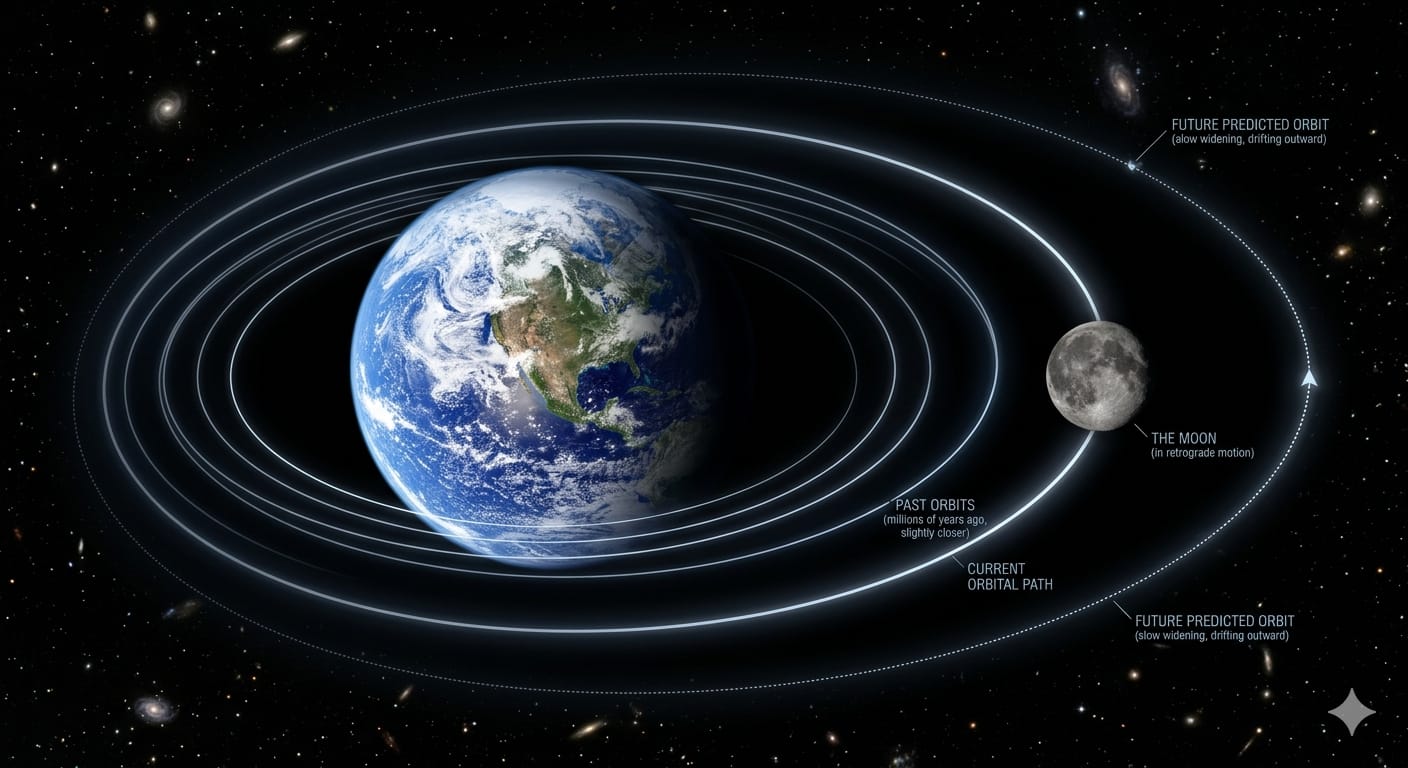
The Moon is slowly breaking up with us. Driven by tidal interactions between Earth’s oceans and the Moon, gravitational energy is being transferred from our planet’s rotation to the Moon’s orbit.
As a result, the Moon is drifting away from Earth at a rate of about 3.8 centimeters (1.5 inches) per year.
While 3.8 centimeters might sound like a negligible crawl—roughly the same speed at which human fingernails grow—over millions of years, that distance adds up dramatically.
 The Great Cosmic Drift
The Death of the Total Solar Eclipse
As the Moon pushes further out into space, its apparent size in our night sky will continue to shrink. Eventually, it will appear too small to fully cover the Sun.
Scientists estimate that in about 600 million years, the Moon will have drifted too far to create a total solar eclipse. Instead, future inhabitants of Earth will only ever witness annular eclipses— where a “ring of fire” remains visible around the dark silhouette of the Moon, but the eerie perfection of absolute totality is lost forever.
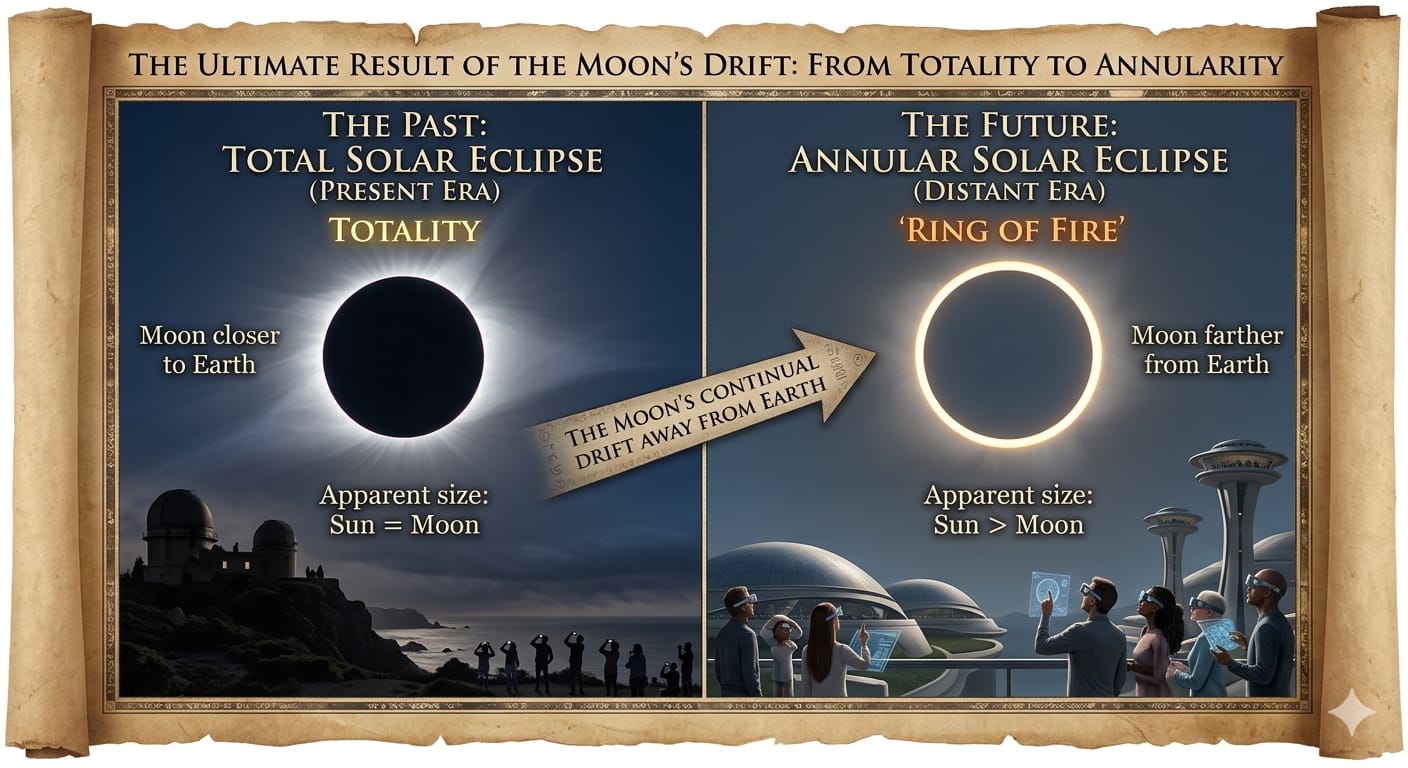
The total solar eclipses we witness today are a luxury of our specific timeline. No future civilization, no matter how advanced, will ever get to stand in the shadow of a perfect total eclipse on Earth.
So, the next time a total solar eclipse crosses your path, don’t miss it. You are witnessing a fleeting masterpiece of celestial mechanics that the universe will eventually erase forever.