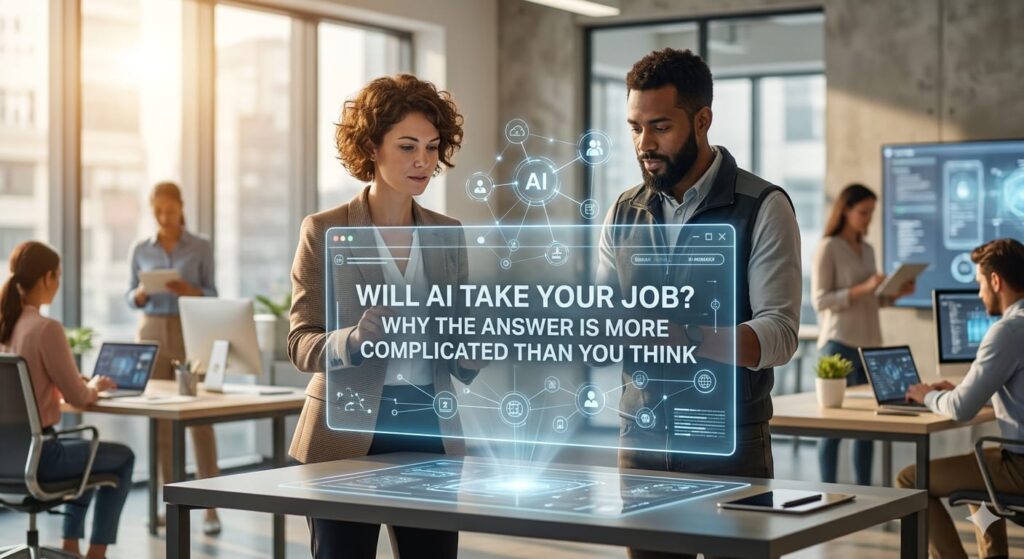

The conversation surrounding Artificial Intelligence often feels like a scene lifted directly from a sci-fi thriller. Headlines scream about “inevitable job displacement,” “automation waves,” and machines taking over the office. But if we peel back the sensationalism, the reality is far more nuanced—and, frankly, much more optimistic.
The narrative isn’t about humans versus machines. It’s about a fundamental shift in what we consider valuable work.
1. The Shift from Execution to Curation
For decades, many professional roles were defined by “execution”—the manual, repetitive, or rule based tasks that formed the backbone of our economy. Data entry, basic reporting, and scripted customer interactions are increasingly being handled by intelligent systems.This is actually a massive opportunity. By offloading these time-consuming tasks to AI, human workers are being liberated to focus on curation and direction. Instead of spending hours gathering data, we are increasingly spending that time analyzing what the data means, refining the outputs, and providing the strategic vision that AI still cannot replicate.
2. The Rise of “Human-Machine Teaming”
The future of work is essentially collaborative. Think of AI not as a replacement, but as a hyper-efficient assistant that handles pattern recognition and massive processing, while you provide the “soft skills”— empathy, ethical judgment, and creative context. For instance, in healthcare, AI helps clinicians analyze patient scans faster and more accurately, yet the doctor remains the expert who interprets the diagnosis and provides the essential human connection during a patient’s most vulnerable moments. It’s a partnership, not a displacement.
3. New Horizons: Roles We Haven’t Imagined
History shows us that every major technological revolution replaces some jobs while creating entirely new categories. We are already seeing the emergence of roles that didn’t exist just a few years ago: AI Ethicists (who ensure technology is used responsibly), Prompt Engineers (who bridge the gap between human intent and machine execution), and Human-Machine Teaming Managers.
The “Skill-First” Future
The most significant impact of AI is the shift from degree-based hiring to skills-based hiring. Because the tools we use are changing so rapidly, employers are valuing your ability to learn, adapt, and use AI tools over your traditional, static qualifications. If you are worried about your future career, don’t focus on competing with AI. Focus on the “Meta Skills” that will keep you indispensable: Critical Thinking, Adaptability, and Emotional Intelligence.